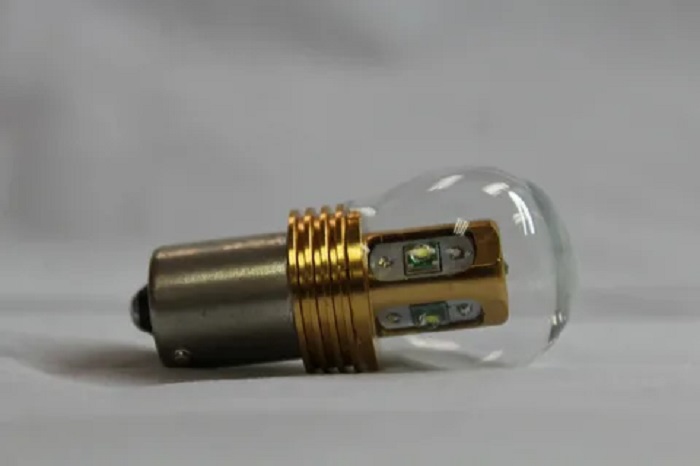
Two bulbs that share a glass envelope shape, a bayonet mount and a colour can still be different products. The 1156 and 1157 are the standard example, and the confusion is not caused by anything visible at a glance. It is caused by what sits on the underside, and by how many separate circuits the lamp housing is trying to feed.
The distinction is contact count. A 1157 is generally a dual-contact bulb in a BAY15D base, built for positions that combine two functions in one housing: a dim running or tail light together with a brighter brake or turn signal. A 1156 is generally a single-contact bulb in a BA15S base, built for positions with one circuit, such as many reverse lights and single-function indicators. The offset of the two index pins differs between the bases, which is why one will seat in a socket intended for the other but then fail to make both connections.
Read the housing before reading the bulb. If the vehicle runs two separate feeds to that lamp position, a dual-contact bulb is the starting point. If it runs one feed, a single-contact bulb is the relevant fitment. Confirming this with a multimeter takes less time than processing a return, and it is the correct order of work, because a bulb can appear to fit physically while leaving one required circuit dead.
Polarity adds a second layer once LED replacements enter the picture. A filament bulb does not care which way current flows; an LED assembly does. Reversed wiring produces a lamp that appears dead rather than one that appears wrong, which misleads installers into replacing a good bulb. Any approval process for a signal product should include a polarity check in both directions and a note on what the product does when it is installed backwards.
Behaviour under load is the third item that specification sheets usually omit. LED replacements in turn-signal circuits commonly cause hyper-flashing, because the vehicle’s monitor measures current and the LED draws far less of it. The correct response is a load compensator matched to the circuit, not a different bulb. A sample that fits the socket but leaves the vehicle reporting a fault has not passed, whatever it looks like.
A written comparison is worth keeping when ordering replacements across a mixed fleet, since the differences are easy to lose when buying by appearance. This 1156 vs 1157 bulb fitment guide sets out the base references, contact counts, circuit counts and typical applications side by side, and makes the practical point that the bulb number is a fitment reference rather than a brightness rating or a guarantee of any particular vehicle application.
The numbering family extends further than two parts, and each branch brings its own substitute question. W5W, 168 and 194 describe one wedge-base family used across interior and position lighting, where the distinctions are wattage and filament rather than physical fitment. 3156 and 3157 are the wider-angle counterparts to 1156 and 1157, and 7440 and 7443 sit in the T20 family used for reverse, brake and tail duties. A buyer covering several markets will meet all of them, and each substitution should be verified by circuit rather than by catalogue equivalence.
For distributors and private-label programmes, the fitment record should travel with the product. Confirm the vehicle manual reference, the original bulb marking, the socket type, the required colour, the polarity behaviour and the electrical result on a real vehicle. Then map that record to the SKU, so the packaging, the compliance documentation and the sales conversation all describe the same item.
Sample against the application, not the part number. Two hundred units of the wrong contact configuration cost the same as two hundred of the right one and sell to nobody.