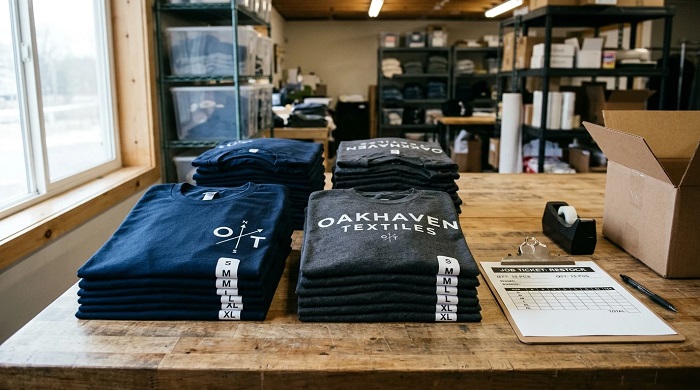
When garment decorators quote small-batch corporate uniform restocks of five to thirty cotton polo shirts or crewnecks, commercial direct-to-garment (DTG) printing achieves a lower total job cost than traditional screen printing whenever multi-colour screen preparation, emulsion exposure, and press registration time cost more than the slightly higher per-shirt ink expense of digital printing.
For regional businesses, restaurant groups, and service contractors that hire new staff monthly, understanding this setup-versus-unit-cost crossover allows print shops to convert unprofitable screen-printing minimums into recurring, high-margin digital uniform accounts.
Why Frequent Staff Restocks Break Traditional Screen-Printing Economics
Traditional screen printing remains unbeatable for five hundred identical single-colour event tees, because the fixed labour of coating, burning, registering, and reclaiming screens is amortised across hundreds of impressions. However, B2B uniform management rarely behaves like a one-off promotional giveaway. A forty-person plumbing contractor, hospitality group, or logistics depot typically orders an initial batch of shirts and then requests six to fifteen replacement garments every few weeks as new employees join.
When a client’s left-chest company logo contains four spot colours, subtle shading, or a fine tagline—and needs to be printed across a mix of navy cotton tees, charcoal long-sleeves, and heavyweight cotton hoodies—screen printing hits an immediate operational wall:
- Screen setup exceeds print runtime: Burning and registering four to six screens for a twelve-shirt restock takes longer than pulling the squeegee, forcing the shop either to charge an unpopular setup fee or absorb a loss on press time.
- Colourway changes require ink washouts: If two supervisor shirts in the batch need white text on navy fabric while ten crew shirts need dark navy text on heather grey, screen printers must stop and wash down screens mid-job, whereas a DTG operator simply swaps the digital art file in the RIP queue.
- Zero physical screen storage: Digital artwork and RIP presets live in client folders on a server, eliminating the shelf space needed to archive dozens of stretched frames for repeat corporate accounts.
Comparing DTG, Screen Printing, and Embroidery for Corporate Cotton Workwear
Print shops advising B2B uniform buyers should position commercial DTG as a precision complement to screen printing and embroidery, matching each decoration method to order volume, graphic detail, and placement size.
| Order Characteristic | Commercial DTG Printing | Traditional Screen Printing | Multi-Head Embroidery | Best Shop-Floor Routing |
|---|---|---|---|---|
| 5–30 piece multi-colour restocks | Near-zero setup changeover; load saved RIP file and print immediately | High fixed screen-burning and registration overhead per colour | Digitising fee (first run) + long stitch time on large back graphics | Route short multi-colour cotton restocks directly to DTG |
| Full-back graphics + left-chest logo | Prints detailed full-back art and crisp chest logos with soft breathable hand-feel | Economical only when identical run volume amortises two separate multi-screen setups | Heavy stitch count on full-back cotton tees causes puckering and stiff wear | Use DTG for full-back graphics and detailed multi-colour chest logos on cotton tees |
| Per-employee name or role personalisation | Variable data (staff names or department titles) handled directly in digital artwork | Impossible without burning a separate screen for every individual name | Requires manual or barcode hoop queueing per name | Handle variable-text cotton shirts on DTG in a single batch run |
| Optimal fabric & durability boundary | 100% cotton and high-cotton work tees/hoodies; requires proper pre-treatment and full curing | Broad fabric range once inks and additives are matched | Heavyweight piqué polos, structured caps, and fleece jackets | Keep high-cotton uniform tees and hoodies on DTG; route caps and structured jackets to embroidery |
Standardising Uniform Repeatability Across Mixed Garment Sizes
To retain corporate uniform accounts year after year, a print shop must ensure that a batch of ten replacement shirts printed in November matches the exact colour tone and placement of the fifty shirts delivered in May. In a commercial DTG workflow, repeatability relies on locking three production parameters inside the customer’s job ticket.
First, record the exact platen size and collar drop distance used for each garment size tier (for instance, using a standard adult platen for S–XL and a wide platen for 2XL–4XL, with a fixed 7 cm drop from the collar seam for left-chest logos).
Second, lock the pre-treatment spray gram weight and RIP white-underbase preset to the specific blank brand and colour code. Because corporate navy and charcoal dyes vary slightly between apparel mills, keeping a dedicated RIP queue profile for each client’s approved cotton blank prevents shade drift on restocks.
Third, enforce verified curing temperature and dwell time. Corporate work shirts undergo frequent domestic laundering; verifying with a non-contact pyrometer or temperature strip that the entire ink film reaches the ink manufacturer’s specified curing threshold ensures reliable wash performance.
Selecting Compact Commercial DTG Hardware for Dedicated Restock Cells
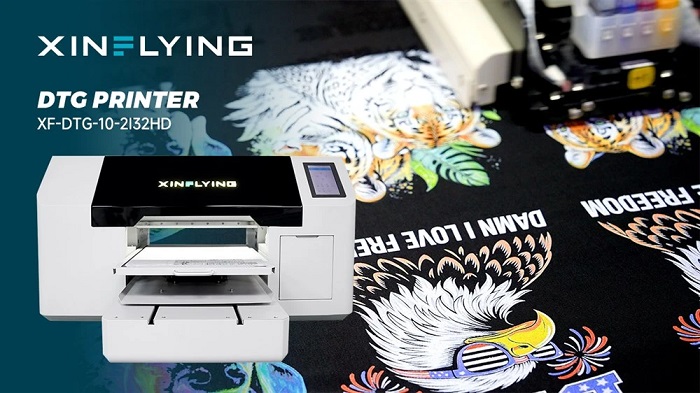
Not every print shop needs a massive factory floor to run profitable B2B uniform orders. Many screen printing and embroidery shops install a compact commercial DTG unit as a dedicated «quick-restock cell» to handle short runs, new-hire fill-ins, and multi-colour samples without interrupting their main carousels. Shop owners evaluating compact industrial platforms such as the XINFLYING XF-DTG-10—or comparing higher-volume configurations like the XF-DTG-20 series—can explore the complete XINFLYING DTG printing machines catalogue to match footprint, platen options, and printhead count to their daily uniform demand.
By routing five-to-thirty-piece multi-colour cotton uniform orders to a dedicated system like the XINFLYING XF-DTG-10, garment decorators can eliminate small-order screen bottlenecks and offer corporate clients fast, no-minimum restock fulfilment.