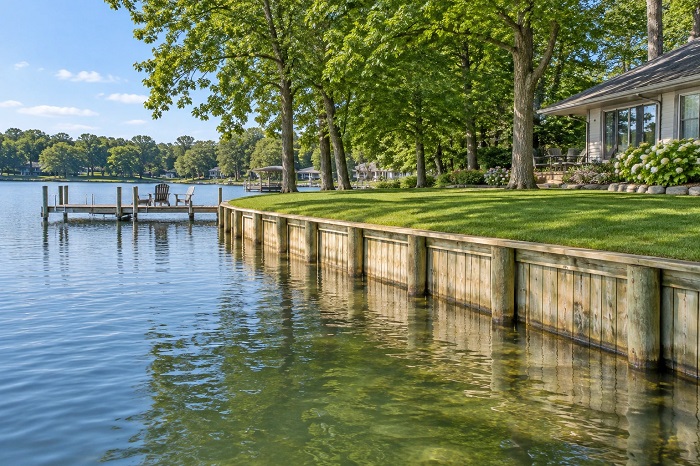
Wooden bulkheads remain a practical option when the shoreline conditions match the material. Shore Protect Team identifies pressure-treated lumber as an optimal choice for freshwater lakes and rivers with calm water, where the project can balance initial cost, appearance, and ongoing maintenance.
The company’s lakefront construction services include docks, piers, piling, and other lakefront structures, so a wooden bulkhead can be planned as part of a larger freshwater property rather than as a standalone wall. The foundation and shoreline conditions still determine how the wall must be supported.
The bulkhead page lists wood construction starting at $150 per linear foot for labor and materials and states a 40-50 year service life with proper maintenance. That service-life statement should be read together with the maintenance requirement rather than as an automatic lifespan for every installation.
Calm water reduces the emphasis on heavy wave resistance compared with open shoreline conditions, but the wall still retains soil and may require piles, tie-back anchors, and drainage. Soil type and wall height continue to matter.
Wood also has to be separated from untreated general-purpose lumber. The page specifically describes pressure-treated lumber as the material used for wooden bulkheads. That is the confirmed product category for this service.
The wood bulkhead information should therefore be evaluated as a complete shoreline system: treated lumber on a site where the water conditions, soil, access, foundation, and maintenance plan support its use.
Where wood fits best on the service page
The strongest fit identified by Shore Protect Team is calm freshwater lakes and rivers. This does not mean every lake property should use wood, but it does define the environment where the material is positioned most clearly.
Properties with active waves, strong coastal exposure, or hurricane-zone conditions may shift the discussion toward other materials. The water body and exposure should be reviewed before price becomes the deciding factor.
Maintenance is part of the ownership cost
The page links proper maintenance with the stated 40-50 year service life. An owner should therefore consider whether routine care fits the long-term plan for the property.
This maintenance requirement is one of the clearest differences between wood and the vinyl option, which the page describes as requiring no additional maintenance.
- Material — Pressure-treated lumber.
- Best-fit environment — Calm freshwater lakes and rivers.
- Starting reference — From $150 per linear foot for labor and materials.
- Service-life statement — 40-50 years with proper maintenance.
- Foundation — Still depends on soil conditions and required pile depth.
- Restraint and drainage — Tie-backs and drainage remain site-dependent structural considerations.
Wood does not simplify the foundation
A wood wall can still sit on soft soil, retain a tall bank, or occupy a site with difficult access. The service page notes that soft soils can require deeper piles and that tie-back quantity depends on wall height and soil type.
That means the material’s cost and appearance do not determine the full project. The foundation and structural systems remain specific to the property.
- Confirm that the shoreline is appropriate for a wooden bulkhead.
- Review soil type and required pile depth.
- Assess wall height and tie-back requirements.
- Plan drainage for groundwater pressure where needed.
- Confirm equipment access along the wall line.
- Include long-term maintenance in the ownership decision.
When wood becomes a sensible choice
Wood makes the most sense when several conditions line up: the water body is relatively calm, the foundation can be built appropriately, the owner accepts the maintenance requirement, and the project goals fit the material’s cost and appearance.
Choosing wood because it has the lowest listed starting price among the vertical wall options is not enough. The better decision connects the treated-lumber system to the actual freshwater shoreline and to a realistic plan for maintaining it over time.
Wood should be compared on total ownership, not only starting price
The published starting figure makes treated wood attractive for budgeting, but the service-life statement is explicitly tied to proper maintenance. An owner comparing wood with vinyl should therefore consider not only the initial per-foot reference but also the willingness to maintain the wood over time.
This does not require assigning an unsupported future maintenance cost. It simply means the decision should acknowledge that wood and vinyl create different ownership responsibilities. The page provides enough information to make that distinction without guessing at future expenses.
On a residential lake or river, this can become a straightforward tradeoff between a material positioned for calm freshwater and a material positioned for reduced routine care. The site still has to support either option structurally, but the maintenance preference can help decide between otherwise suitable systems.
Freshwater does not automatically mean the entire shoreline is calm
Even on a lake or river, local exposure can vary with orientation, boat traffic, currents, and the shape of the shoreline. The page positions wood for calm freshwater conditions, so the property should still be reviewed to confirm that the proposed wall line fits that description. A protected cove and an exposed point on the same lake may lead to different material discussions.
Wood repair can preserve serviceable sections
Because Shore Protect Team offers restoration of damaged bulkhead sections, an aging wood wall should be assessed by condition rather than assumed to need complete replacement. Localized repair can make sense when the remaining structure, anchors, and foundation are still serviceable. The repair scope should identify exactly what stays and what is replaced.